
Introduction
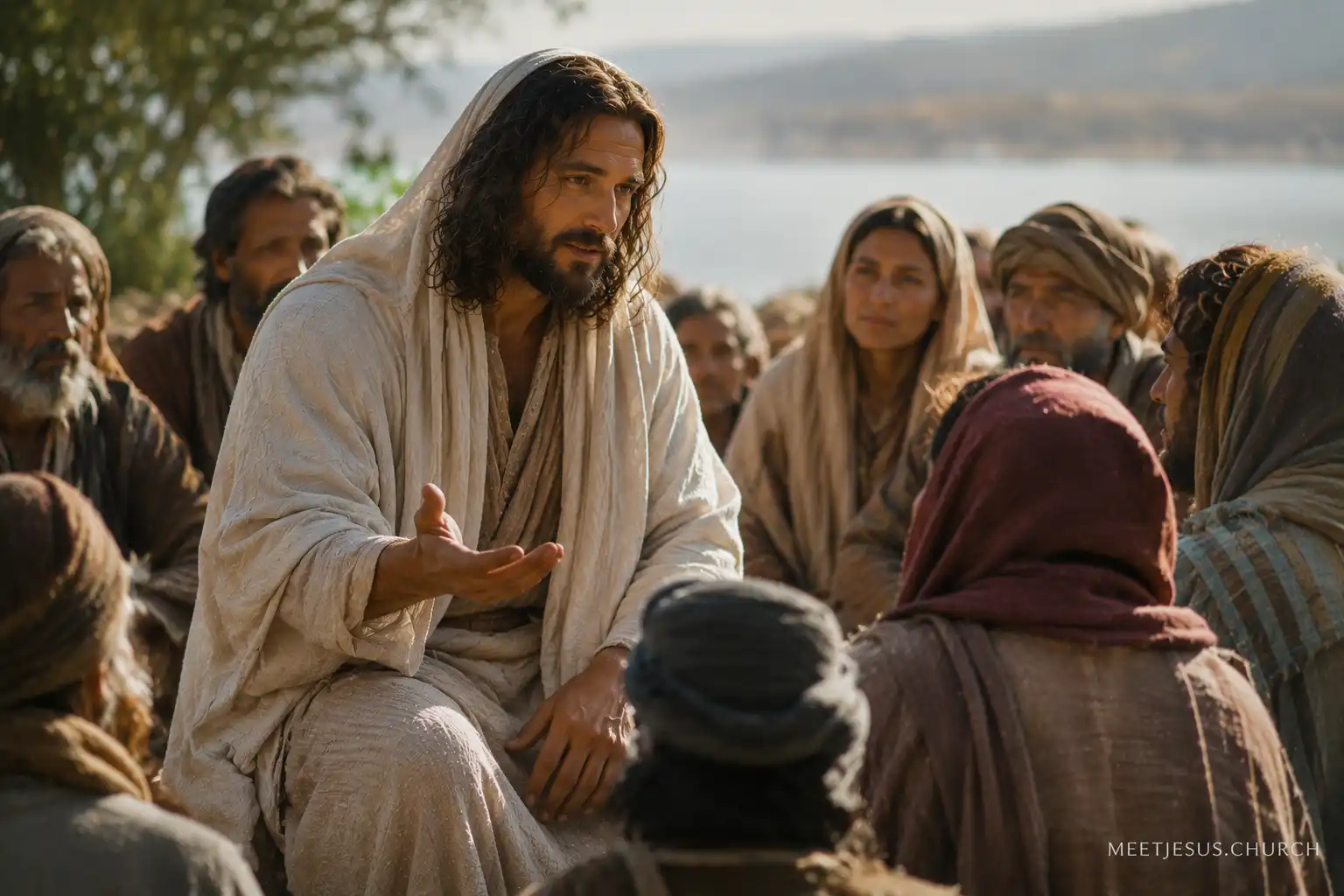
This question may seem simple, even marginal, compared to the major theological questions readers often ask about Jesus: Was he really crucified? Is he God? What is the truth about the Trinity? But the question of language, despite its apparent simplicity, leads to something important: to Jesus the historical human being, the son of Nazareth, who lived in a small Galilean village, and who spoke, laughed, debated, and taught in a real human language with its own dialect and accent. Knowing this language doesn’t change doctrine, but it brings the picture closer and reminds us that the Gospel speaks of a man who lived in a specific time and place, not a mythical figure abstracted from history.
What’s striking is that this very question brings Christian and Muslim researchers together on a remarkably similar answer, even if the details and sources each side relies on differ. Let’s begin with the land where Jesus was born and raised.
First-Century Palestine: A Multilingual Land
Palestine in Jesus’s time was not a monolingual environment. It was a crossroads where three or four languages overlapped depending on context: who was speaking to whom, where, and for what purpose. Aramaic was the language of daily life for ordinary people in Galilee and Judea; Hebrew was the language of religious rituals and sacred texts in the synagogue; Greek was the language of commerce and administration in the region’s major cities; and Latin was the official language of Roman rule, though its use among ordinary Jews was exceedingly rare.
This diversity is not a theoretical assumption; the Dead Sea Scrolls, discovered since 1947, have shown texts in Hebrew, Aramaic, and Greek together from the same region and period, confirming that the Jewish community in Palestine was truly multilingual, not monolingual as some early scholars assumed.
Aramaic: Jesus’s Mother Tongue According to the Gospel
There is near-unanimous scholarly consensus among biblical historians that Aramaic was the primary language Jesus spoke in his daily life and in teaching the crowds. The strongest evidence for this is not an external inference, but is found within the Gospel text itself: although the Gospels were written in Greek, they preserve certain Aramaic phrases spoken by Jesus, with the Gospel writer appending the Greek translation alongside—as if wanting the reader to hear the original sound before understanding the meaning.
“Taking her by the hand, he said to her, ‘Talitha koum!’ (which means, ‘Little girl, I say to you, get up!’)”
Mark 5:41 — at the raising of Jairus’s daughter
The most prominent example of all is what Jesus uttered on the cross, in the final moment of his earthly life, when he cried out in Aramaic words preserved in two slightly varying forms according to the Gospel writers:
“Eloi, Eloi, lema sabachthani?” (which means, “My God, my God, why have you forsaken me?”)
Mark 15:34 (with a similar form in Matthew 27:46)
This phrase quotes Psalm 22, but it appears in the Gospel in its colloquial Aramaic form, not in the original Hebrew of the Psalm text—a point most linguistic scholars favor based on the verb “sabachthani” meaning “forsaken,” which is Aramaic, not Hebrew. This means that even in his most intense moment of quoting the sacred Hebrew text, Jesus was recalling it in his mother tongue, the language he thought in: Aramaic.
Other Aramaic words preserved in the Gospels confirm the same picture: “Abba” (Father) in Jesus’s prayer in Gethsemane (Mark 14:36); “Ephphatha” (Be opened) at the healing of the deaf man (Mark 7:34); and “Corban” meaning a gift dedicated to God (Mark 7:11). These words would not have been preserved in their original form unless they were part of the living memory of those who actually heard Jesus speak them.
Hebrew and Greek: Did Jesus Know These Too?
Aramaic was his daily language, but that doesn’t mean it was his only one. Textual evidence suggests Jesus also had good knowledge of Hebrew, the language of religious rituals and sacred texts in his time. The Gospel of Luke portrays him standing in the synagogue at Nazareth reading from the scroll of the prophet Isaiah in Hebrew before the congregation (Luke 4:16-21), which would have required mastery of that language, not just superficial familiarity.
As for Greek, the matter is more complex. Greek was the dominant international language in the eastern Mediterranean since the conquests of Alexander the Great—something like English today—and it is likely that Jesus understood some of it and used it occasionally when speaking with non-Jews, as in his encounter with the Roman centurion (Matthew 8:5-13) or before Pilate, the Roman governor of Judea (John 18:33-38), though the Gospels do not explicitly state in which language that final dialogue occurred.
The only passage that explicitly mentions three languages together is the description of the inscription placed above Jesus’s head on the cross:
“Pilate had a notice prepared and fastened to the cross… written in Aramaic, Latin and Greek.”
John 19:19-20
This text reflects the actual linguistic reality of the scene itself: a notice written in three languages so that anyone passing by could read it, regardless of their first language—living proof that Jerusalem at that moment was a place where the Jewish, Roman, and Greek worlds intersected.
The Language of Jesus (Peace Be Upon Him) in Islamic Tradition
Most Muslim scholars of interpretation and linguistics agree with the same picture presented by the Gospels, though terminology differs: that the language of Jesus (peace be upon him) and his people was Hebrew or Syriac (Aramaic), two very closely related languages from the same Semitic family. According to fatwas from IslamWeb, the mother tongue of Jesus (peace be upon him) was most likely Syriac, one of the Semitic languages prevalent in the Levant during his time.
This view is not an absolute consensus; Ibn Taymiyyah disagreed in one passage of his book Al-Jawab al-Sahih, arguing that Christ spoke only Hebrew, and that those who said his tongue was Syriac (Aramaic) were mistaken. However, linguistic specialists note that this view faces a historical difficulty: by the first century CE, Hebrew had receded to a liturgical religious language after the Babylonian exile, while Aramaic/Syriac was the living, commonly spoken language in the Levant—which aligns precisely with the picture presented by the New Testament itself: Hebrew for rituals, and Aramaic for daily life.
What the reader may notice here is something striking: the Qur’an, when describing Jesus (peace be upon him) speaking from the cradle, does not specify the language in which he spoke, saying:
“He said, ‘Indeed, I am the servant of Allah. He has given me the Scripture and made me a prophet.'”
Surah Maryam 19:30
The Qur’anic text focuses on the content of the speech, not its language—and this actually aligns with the approach of the Gospels themselves, which were written in Greek but preserved Aramaic echoes here and there as a linguistic trace of Jesus’s actual speech, not as a comprehensive linguistic record of everything he said.
Comparative Table: Languages in the World of Jesus / Jesus (Peace Be Upon Him)
| Language | Its Role | Evidence |
|---|---|---|
| Aramaic | Language of daily life and teaching | “Talitha koum” (Mark 5:41) |
| Hebrew | Language of rituals and synagogue reading | Reading Isaiah (Luke 4:16-21) |
| Greek | Language of communication with non-Jews and administration | The cross inscription (John 19:20) |
| Latin | Official language of Roman rule | No evidence Jesus spoke it |
Why Does This Question Matter at All?
The reader may ask: What difference does this linguistic knowledge make? The difference is that Jesus, in both the Christian and Islamic traditions, was not a being abstracted from time and place, but a man born in a specific village, raised with a specific dialect, who addressed farmers and fishermen in their simple language, not in the language of the religious elite or the foreign ruler. This linguistic choice itself carries significance: one who chose to speak in the language of ordinary people also chose to be close to them, not distant from them in an elitist tower.
And here the Muslim reader meets this truth from a familiar angle: the Qur’an itself was revealed in the language of the people of the Prophet Muhammad ﷺ, not in a foreign language to them—and the divine wisdom in this is the same in both texts: that God addresses people first in their own tongue, so that they may understand, and then believe.
A Reflective Conclusion
When we imagine Jesus today, we often conjure an image abstracted from all context: a face without an accent, a voice without a dialect. But history returns us to a more realistic picture: a Galilean man who spoke in the Aramaic dialect of his village, read Hebrew in the synagogue, and perhaps stumbled a little in Greek when addressing a stranger. Isn’t it worth asking: Does our true knowledge of Jesus, as a human being who lived in a specific time and place, bring us closer to his image than the abstract picture we have formed of him in our minds?
For Direct Reading
• Mark 5:35-43 (Talitha koum)
• Mark 15:33-37 (Eloi, Eloi, lema sabachthani)
• Luke 4:16-21 (Jesus reading in the synagogue at Nazareth)
• John 19:16-22 (The trilingual inscription on the cross)
• Surah Maryam 19:27-33 (Jesus speaking from the cradle)