
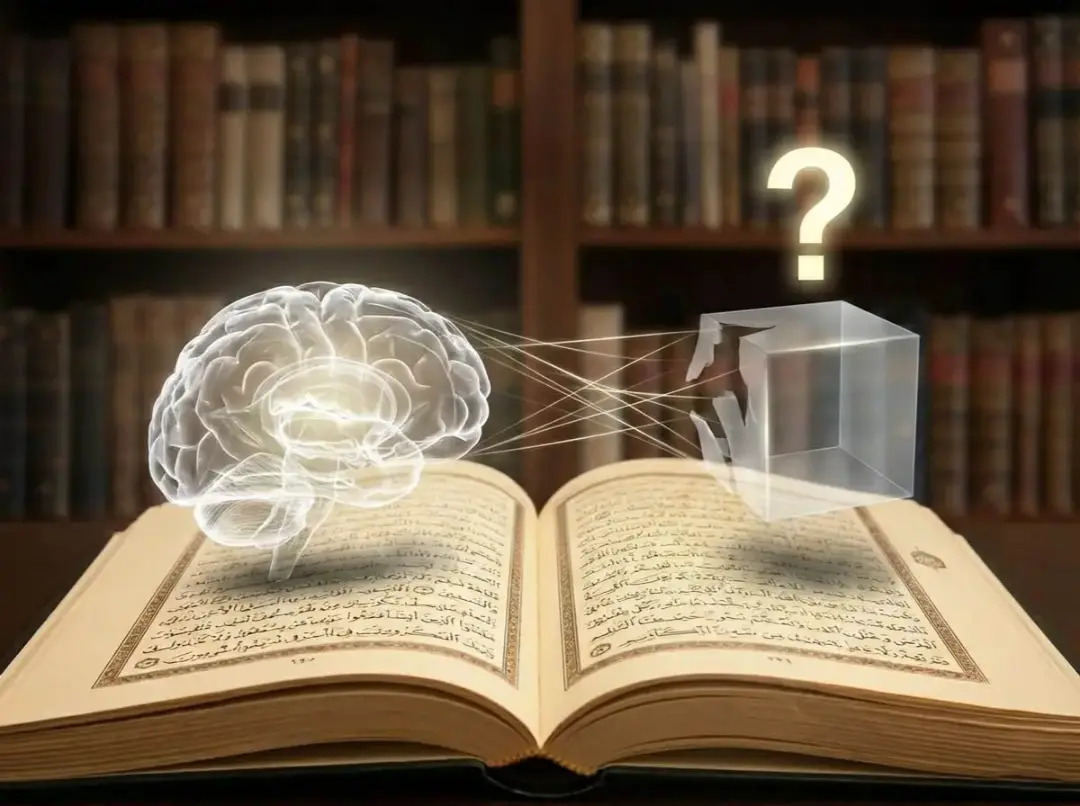
It is a conceptIncarnationIt is one of the most profound ideas that raises profound mental questions for Muslims. It is often rejected not because it has been studied philosophically, but because it seems – at first glance – to contradict monotheism.
But the precise philosophical question is not:
Do I believe in incarnation?
but rather:Is incarnation mentally possible in principle?
First: What is meant by incarnation (with philosophical precision)?
Incarnation in Christian thought does not mean:
- ❌ God turned into a human being
- ❌ Or that divinity changed into humanity
- ❌ Or that God became limited to a body
Rather, it means:
That God is infiniteHe took on human natureWithout losing his divine nature.
any:
- The divine has not ceased
- And the human being has not been cancelled
- Rather, they came together without mixing or separating
This is what is attributed toJesus ChristIn the Christian faith.
Second: Is this a mental contradiction?
The mental contradiction occurs if it is said:
A thing is and its opposite at the same time and in the same sense.
But the incarnation does not say:
God is both limited and infinite at the same time
Rather, he says:
God is unlimitedIn his divine nature
And take the limitedIn his human nature
That is, talking aboutTwo naturesNot about one contradictory nature.
Logically:
- Multiplicity of characteristics ≠ contradiction
- Multiple levels ≠ contradiction
Third: A simplified (approximate) philosophical example
⚠️ The example is for approximation, not for complete simile:
- The writer writes a novel
- He remains a writer outside the novel
- But he can enter the novel as a character
- Without ceasing to be a writer
author:
- It did not turn into ink
- He did not lose consciousness
- But he became present within the story
Idea:
Presence does not equal conversion
Conjugation does not equal mixing
Fourth: Does the incarnation conflict with the greatness of God?
The real philosophical question:
Does God’s greatness mean absolute dimension?
Or absolute power?
If we say:
- God is great because He does not come close → This is a restriction
- God is great becauseHe appreciatesTo come close without decreasing → this is perfection
In Islamic thought:
- God speaks to humans
- He sends a revelation
- Interferes in history
Why would it be:
- Talking is possible
- Revelation is possible
- But personal proximity is impossible?
The ban here is not mental, but hypothetical.
Fifth: Does incarnation threaten monotheism?
In Islam:
- Tawhid = unity without internal differentiation
In Christianity:
- Tawhid = unity in essence with differentiation in relationship
The difference is not in the number of gods (they both say one),
But inVisualize the unit itself.
Philosophically:
- Unity does not necessarily mean absolute simplicity
- Abundance does not necessarily mean polytheism
Al-Faisal is:
Is the essence one or multiple?
Christianity affirms: the essence is one.
Sixth: Why does Christian thought resort to incarnation at all?
Because the existential question was:
How does a person truly know God?
- The text tells
- The Prophet indicates
- butThe personHe defines himself
In the Christian vision:
- God didn’t just send a message
- Rather, he entered history to make himself known
This is what Christians associate withGospel of JohnWhen he says:
“And the Word became flesh and dwelt among us.”
Seventh: Philosophical Conclusion
- IncarnationNot a logical contradiction
- There is no mental impossibility
- Rather, it is a possible metaphysical assumption
- It is rejected or accepted based on the theological vision, not on reason alone
The last question is not:
Do I like the idea?
but rather:
Could it be that God – if He willed – approached man in this way?
A final word for the researcher
A sound mind does not reject before understanding, and does not accept before weighing. Incarnation, philosophically, is not a departure from reason, but rather a departure fromFashionable.