
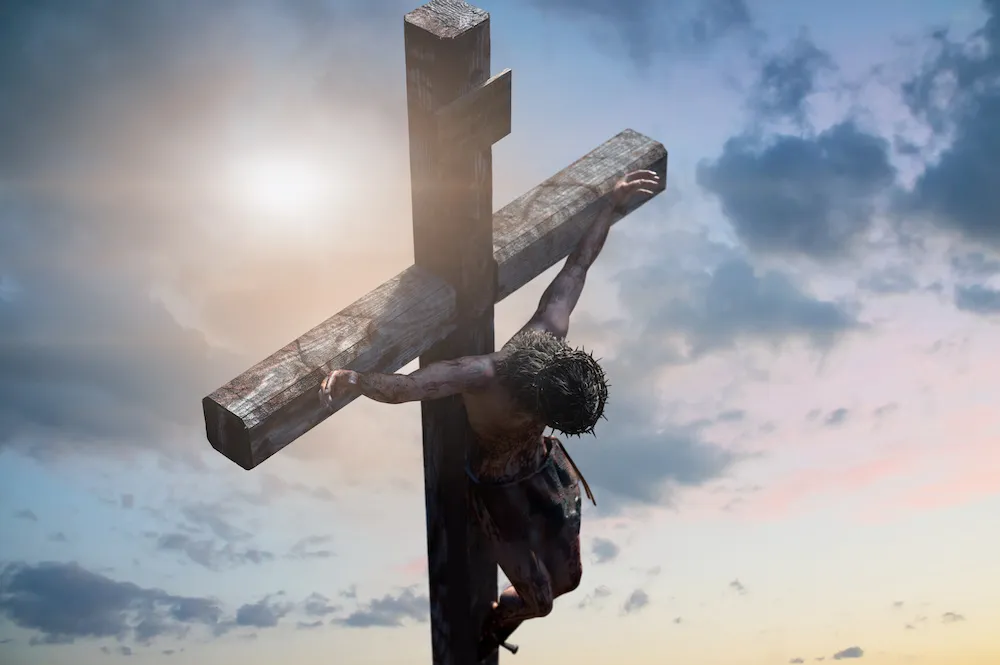
This question touches the heart of the Gospel. How does the Father ask His Son to die? Where is the justice in having a perfect human being suffer instead of sinful human beings? Let us meditate together on this great mystery.
First: Did God “kill” his son?
Let’s start by correcting a common idea. Christians do not believe that the Father “killed” the Son or was angry with him. This is a wrong understanding. The Gospel declares that the entire Trinity was working together to save mankind.
The Apostle Paul says: “God was in Christ, reconciling the world to himself” (2 Corinthians 5:19). That is, God did not need anyone to appease Him, but rather He Himself initiated love and offered Himself as a ransom for us.
Christ says about himself: “No one takes my life from me, but I lay it down of my own accord. I have power to lay it down and I have power to take it up” (John 10:18).
So, Christ was not a victim of murder, but rather an active participant in the plan of redemption. He gave himself willingly.
Second: Where is justice?
Let’s think together a simple story:
Imagine that you owe a very large sum of money that you cannot pay. The sentence is life imprisonment. Suddenly, a very rich person comes along, through no fault of his own, and pays the entire debt from his own money. Is this unfair? Or is it great generosity?
God, in His justice, says that the wages of sin is death (Romans 6:23). We have all sinned and deserve punishment. But God, in His love, He Himself paid the price.
Justice requires that sin does not go unpunished. Love wants to save the sinner. In the cross, justice and love met together. Justice was fulfilled by declaring the punishment for sin, and love was fulfilled by God Himself bearing this punishment on our behalf.
Third: Redemption in Christian thought
Let’s take another example: If your son fell into a deep river, would you think before you jumped in to save him? Of course not. You immediately jump in because you love him. You may be in danger and you may be injured, but your love drives you to save him.
This is like what God did. We fell into the sin of death, and He jumped to us in the person of Christ. He endured pain and death not because he deserved to be punished, but because he loves us and wants to save us.
The Bible says: “But God demonstrates his love for us in that while we were still sinners, Christ died for us” (Romans 5:8).
Fourth: How can one die instead of everyone?
This is a deep question. Christ is not just an ordinary man. He is the “God-man.” Its value is unlimited. Therefore, his death has infinite value, enough to atone for the sins of the entire world.
When John the Baptist saw Jesus, he exclaimed: “Behold, the Lamb of God, who takes away the sin of the world!” (John 1:29). His comparison to a lamb reminds us of the sacrifices of the Old Testament, where the innocent animal died in the place of the sinner. But the blood of Christ is more precious than the blood of animals, because he is the Son of God himself.
Fifth: Innocence and redemption
You may say: “But he was innocent, so how could he be punished?” That’s right, he was completely innocent. The Bible says about him: “He committed no sin, nor was deceit found in his mouth” (1 Peter 2:22).
These were exactly the requirements for the sacrifice in the Old Testament: that it be “without blemish” (Leviticus 1:3). Only the perfect innocent can be a redemption for the guilty.
Let us consider this poignant scene from the Gospel of Matthew:
When Christ was standing before the Roman governor Pilate, Pilate said to him: “Do you not hear how many witnesses they bear against you?” (Matthew 27:13). But Christ did not answer. He was silent as a lamb before his shearers (Isaiah 53:7). Then Pilate said to the crowd: “I am innocent of the blood of this just man!” (Matthew 27:24). Even the pagan ruler testified of his innocence!
Sixth: What does this mean for us personally?
This means that salvation is not something we buy with our good deeds. It is a free gift from God. The Bible says: “For by grace you have been saved through faith, and this not of your own. It is the gift of God. Not of works, lest anyone should boast” (Ephesians 2:8-9).
We do not deserve salvation, but God in all generosity offers it to us for free. All we have to do is accept it with faith.
Conclusion for thought
The cross is not a place of killing, but rather the highest expression of love. God did not kill His Son, but in Christ, God Himself paid the price we would have paid. Justice was done, and love triumphed.
“For he made him who knew no sin to be sin on our behalf, so that we might become the righteousness of God in him” (2 Corinthians 5:21).