
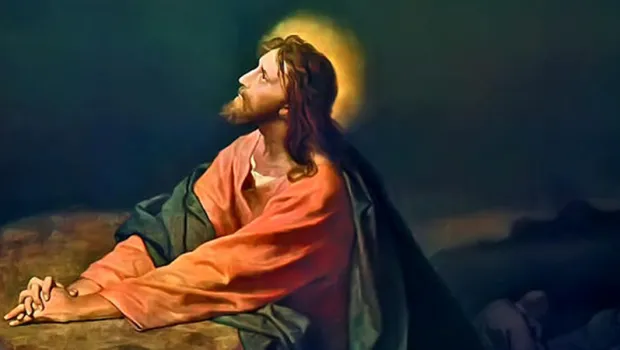
A deep and important question. We read in the Gospel that Jesus prayed a lot. Sometimes he spent the whole night in prayer (Luke 6:12). He teaches his disciples how to pray (Matthew 6:9-13). If Christians believe that Jesus is God, to whom was he praying? Was he praying for himself?
First: The secret of the incarnation
To understand Christ’s prayer, we must first understand the meaning of “incarnation.” Christians believe that Christ is God manifest in the flesh (1 Timothy 3:16). In other words, He is fully God and fully human at the same time.
As we explained in the previous episode about the Trinity, the eternal Son (the Word) “became flesh and dwelt among us” (John 1:14). This means that:
- In terms of his theology: He is the uncreated, eternal, all-powerful God.
- Concerning his humanity: He is a real human being, with a body and emotions. He eats, sleeps, gets tired, cries, and prays.
Second: Prayer as an expression of his full humanity
When Christ prayed, it was an expression of his human nature. He, as a human being, needed communion with the Father. He was providing a model for us to rely on God and obey Him.
Consider with me this beautiful verse: “And while he was in the race, he prayed more earnestly, and his sweat became as drops of blood falling to the ground” (Luke 22:44).
This is not a God far from us, but rather a God who approached us and tasted our pain and weaknesses. He knows the meaning of fear, sadness, and need, because he lived it as a real human being.
Third: Prayer as a relationship between the Father and the Son
In the mystery of the Trinity, there is an eternal relationship of love between the Father and the Son. When Christ was on earth, this relationship appeared in the form of prayer and dialogue.
Before his crucifixion, Jesus prayed his famous prayer: “My Father, if you are willing, let this cup pass from me! However, not my will, but yours, be done” (Luke 22:42).
Here we see:
- love: He calls out, “Father,” as an expression of intimacy.
- obedience: “Thy will be done,” despite the difficulty of what awaits him.
- humility: The Son respects the Father, even though they are one in essence.
Fourth: What about the prayers that were offered to Christ?
This is another important aspect. In the Bible, we see people praying to Christ or prostrating to him, and he accepted that. for example:
A man with leprosy came to him and said, “Lord, if you are willing, you can make me clean” (Matthew 8:2). This was an acknowledgment of his divine power.
Also, when he walked on the water and his disciples saw him, “they came and worshiped him, saying, ‘Truly you are the Son of God!’” (Matthew 14:33). He did not stop them.
Likewise, after the resurrection, Thomas cried out: “My Lord and my God!” (John 20:28), so Christ accepted this confession and blessed him.
Fifth: So, does Christ pray now?
Nice question! After his resurrection and ascension to heaven, we believe that Christ is now seated at the right hand of the Father. But he still plays an intercessory role for believers. The Apostle Paul writes: “Christ is the one who died, but rather also rose again. He is also at the right hand of God, who also intercedes for us” (Romans 8:34).
So, he does not need to pray as a human being now, but he intercedes for us as a great priest.
Conclusion for thought
Christ’s prayer on earth teaches us something beautiful: God is not far from us. In Christ, we see a God who approaches us, lives like us, suffers like us, and prays like us. But at the same time, He is the God who is able to save us and answer our prayers.