
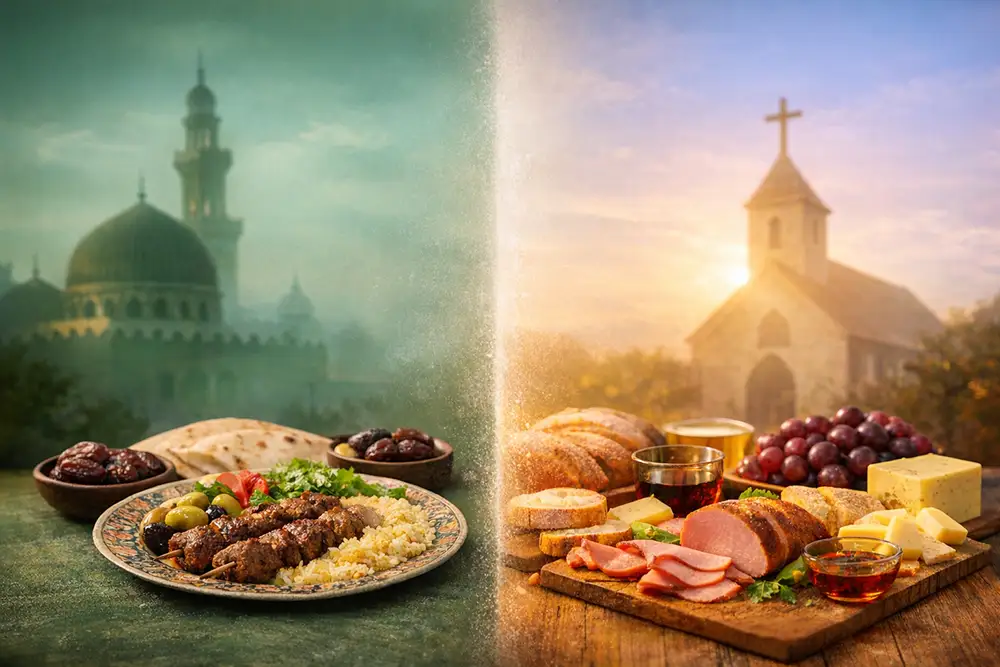
The topic of Halal food, particularly the issue of pork, frequently raises questions in dialogue between Muslims and Christians. While Muslims adhere to a clear prohibition against this type of food, Christians do not view its consumption as a religious issue. To understand this difference, it is helpful to return to the religious texts of both traditions and examine how they are interpreted.
First: the prohibition of pork in Islam
The Holy Qur’an explicitly states that pork is forbidden in more than one place, including:
“Forbidden to you are dead animals, blood, and the flesh of swine…” (Al-Ma’idah 5:3)
This ruling is also repeated in other verses such as (Al-Baqarah 2:173) and (Al-An’am 6:145). It is understood from this that abstaining from pork is part of adherence to Islamic law, and is an expression of obedience to God.
Second: The presence of the same prohibition in the Old Testament
The reader finds in the Bible, especially in the Old Testament, provisions similar to those contained in Islam. In the Law of Moses, it is stated:
“And the pig…is unclean to you. You shall not eat of its flesh” (Leviticus 11:7-8)
This shows that the prohibition of pork was part of religious law that preceded Christianity, and that there is historical common ground between the two religions in this aspect.
Third: The transformation in the New Testament
The fundamental difference appears when looking at the New Testament, where Christians understand that Christ’s message came within the framework of a new relationship with the law.
Among the texts cited in this context are the words of Christ:
“It is not what goes into the mouth that defiles a person, but what comes out of the mouth” (Matthew 11:15)
And in another place:
“There is nothing from outside a man that, if it enters into him, is able to defile him…” (Mark 15:7)
Many Christians have interpreted these sayings as a shift in focus from the purity associated with food to the purity associated with the heart and behavior.
There is also a comment in the Gospel of Mark that reads:
“And thus he purified all foods” (Mark 7:19)
In addition, the Acts of the Apostles mentions a vision of the Apostle Peter in which he said:
“What God has made clean, do not call common” (Acts 15:10)
Taken together, these texts have been understood as indicating that the dietary restrictions of previous Sharia law were no longer binding on believers in Christianity.
Fourth: The difference in approach between Sharia law and faith
It can be said that the difference is not only related to the type of food, but rather to the way of understanding the relationship with God:
In Islam, Sharia law, including dietary provisions, is an essential part of the practice of faith.
In Christianity, these provisions are often seen as part of a previous stage, and that the relationship with God is built primarily on faith and grace, not on literal adherence to dietary laws.
Fifth: The Qur’an’s view of the food of the People of the Book
It is worth noting that the Qur’an refers to a kind of mutual acceptance in this aspect, as it says:
“And the food of those who were given the Scripture is lawful for you” (Al-Ma’idah 5:5)
It is understood from this verse that there is room for coexistence despite differences in some rulings.
conclusion
The issue of pork remains a clear example of the difference in approaches between Islam and Christianity in understanding Sharia law. While Islam maintains the continuity of dietary provisions, Christianity believes that these provisions have acquired a new meaning or are no longer binding.
Such issues can be the gateway to a deeper dialogue, based on understanding and respect, rather than controversy or prejudice.