
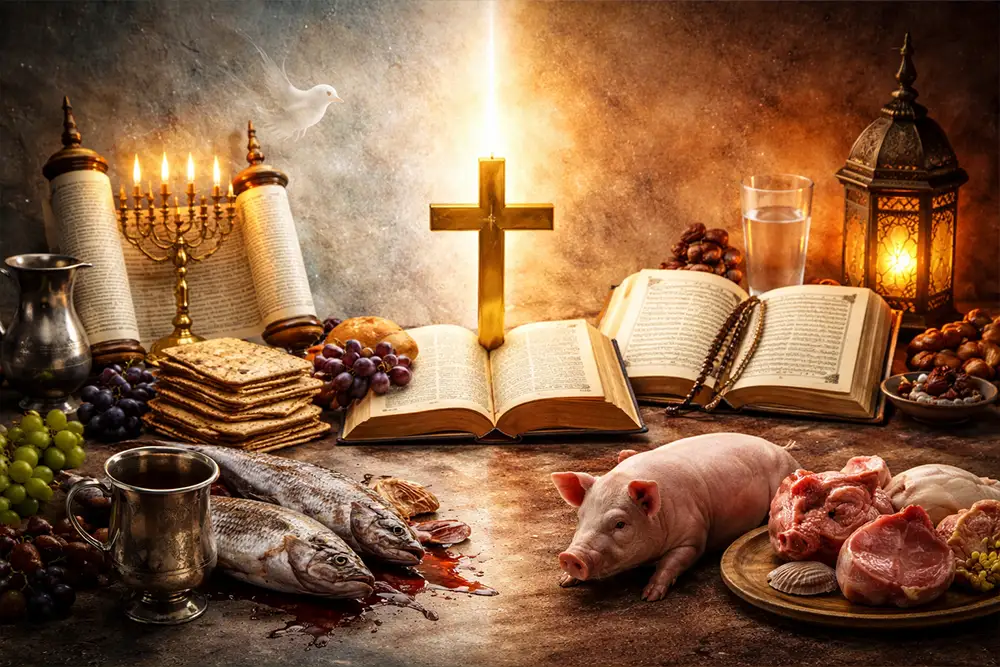
The concept of “the pure and the impure” is a central religious concept in the Abrahamic religions: Judaism, Christianity, and Islam. It is a concept that is not limited to physical cleanliness but extends to include ritual, moral, and spiritual dimensions, with clear differences in application and interpretation among these religions.
First: the concept in Judaism
In Judaism, the concept of purity and impurity occupies a wide and detailed place in the law, especially in books such as Leviticus and Numbers.
- TahorA person or thing prepared for worship or participation in religious rituals.
- Impure (Tamei): A condition that prevents an individual from performing certain rituals until “purification” is completed.
Examples of this include:
- Some forbidden foods such as pork.
- Biological conditions such as menstruation or touching a dead person.
- Animals that are considered inedible according to the laws of Kashrut.
Impurity here is not a “moral sin,” but rather a ritual condition that needs purification through specific procedures.
Second: The concept in Christianity
In Christianity, there was a major shift in the understanding of purity and impurity compared to Judaism.
- In the New Testament, there appears a trend towards “liberating” man from strict ritual restrictions.
- The teachings of Jesus and then the letters of Paul are credited with emphasizing that purity is not only linked to food or external rituals.
For example, it is understood that:
- “What goes into the mouth does not defile a person, but what comes out of it.”
- The focus moved from ritual purity to moral purity (intention, behavior, heart).
However, some Christian denominations still maintain fasts or dietary restrictions, but they are understood as spiritual choices rather than comprehensive mandatory laws.
Third: The concept in Islam
In Islam, there is a balanced system that combines physical and spiritual purity, but it is less complex than the Jewish ritual system.
- Purity (pure): An essential condition for the validity of worship such as prayer.
- impurity (unclean): Specific situations such as urine, blood, or some practices that require washing or ablution.
There are also “halal” and “haram” foods, such as:
- Prohibition of pork.
- Prohibition of dead animals and blood.
- Requiring the legal slaughter of animals.
But in Islam, purity is directly linked to daily worship, and not only to a priestly or class system.
Fourth: similarities and differences
Similarities:
- There is a distinction between what is religiously acceptable and what is unacceptable.
- The concept is linked to worship and closeness to God.
- There are dietary and behavioral rules in every religion.
Differences:
- Judaism: A very detailed and precise ritual system.
- ChristianityA move towards the spiritual and moral dimension rather than the ritual.
- Islam: Integrating physical and spiritual purity into an integrated daily regimen.
Fifth: The philosophical dimension of the concept
Aside from the legislative details, the concept of pure and impure reflects a deeper idea:
- Organizing man’s relationship with the sacred.
- Drawing boundaries between the ordinary and the sacred.
- Building religious awareness that links daily behavior to the spiritual dimension.
Thus, “clean and impure” become not just categories, but a way of understanding the world from a religious and moral perspective.
conclusion
Despite the unity of the Abrahamic origin of these religions, the concept of purity and impurity developed in different ways that reflect the nature of each religion and its vision of man and worship. Between subtle legislation, spiritual transformation, and practical balance, this concept emerges as one of the richest in religious history.