
introduction
When a Muslim or even a general reader reads the Bible, he may notice something remarkable:
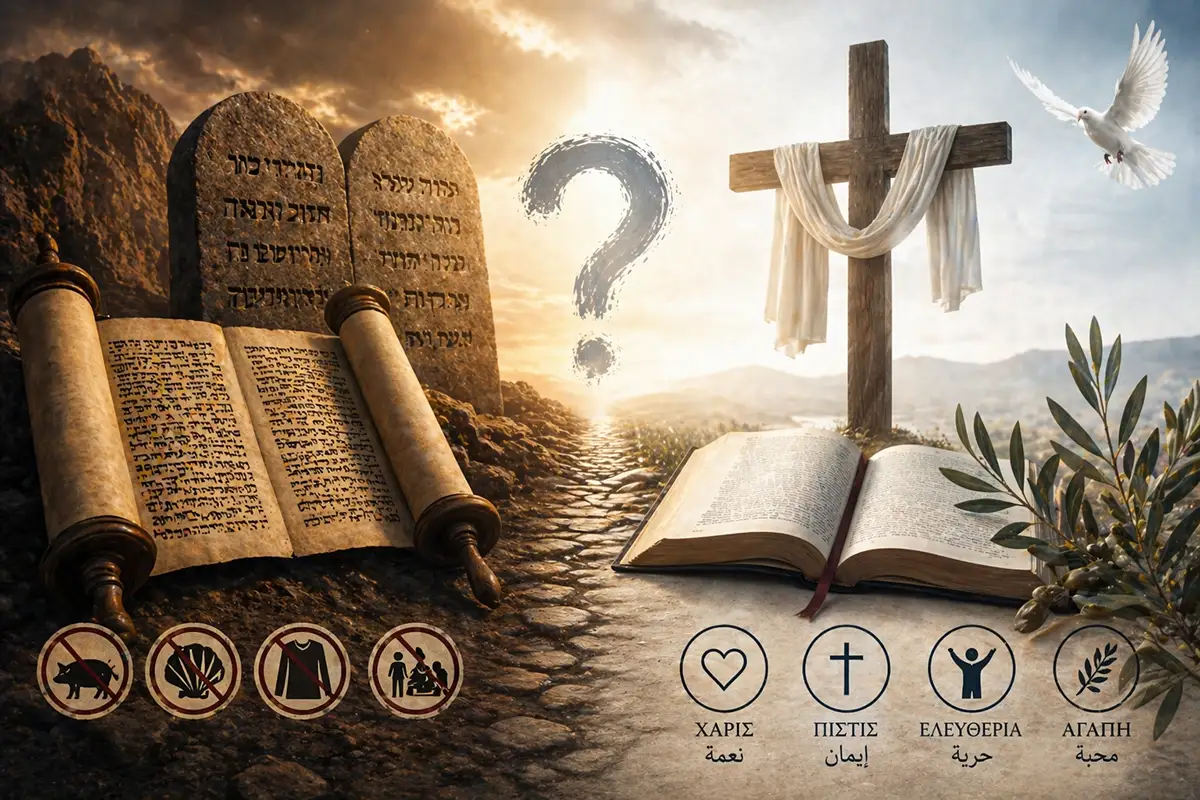
In the Old Testament, there are clear and detailed provisions:
- Forbidden foods
- Rulings of purity
- Circumcision
- Saturday
But when we move to Christianity today, we find that many of these provisions are no longer applied.
So what happened?
Have these provisions been cancelled?
Or was it interpreted differently?
Let’s try to understand the picture calmly.
First: What is the Old Testament for Christians?
Christians believe that the Old Testament is a holy book, and that it contains a law given to the children of Israel.
Christ, peace be upon him, says, according to the Bible:
“Do not think that I have come to abolish the Law or the Prophets; I have not come to abolish but to fulfill.”(Matthew 5:17)
Here an important question arises:
If he did not come to abolish it, how did some of the rulings stop being implemented?
Second: Paul’s role in understanding the law
To understand what happened, we must stop at a central figure in Christianity, the Apostle Paul.
Paul had a great influence in spreading Christianity among non-Jews, and he presented a different interpretation of the law.
He says in his letters:
“For a person is not justified by the works of the law but by the faith of Jesus Christ.”(Galatians 2:16)
As he says:
“For you are not under law, but under grace.”(Romans 6:14)
This is where the idea started:
- Compliance with Sharia law is not a condition for salvation
- And faith is the foundation
Third: What about food and practical provisions?
The most prominent examples: food.
In the Old Testament, there is a clear list of taboos (such as pork).
But in the New Testament, we find texts that are understood differently.
Christ, peace be upon him, is attributed to saying:
“It is not what goes into the mouth that defiles a person, but what comes out of the mouth.”(Matthew 15:11)
There is also a vision of Peter in which he said:
“What God has made clean, do not call profane.”(Acts 10:15)
These texts were later understood as:
- Lifting of dietary restrictions
- Or reinterpret it symbolically
Fourth: Have all the provisions been cancelled?
Here is an important point:
Christians do not say that everything has been abolished, but rather they distinguish between:
- Moral law(Example: Do not murder, Do not commit adultery) → It still stands
- Ritual law(such as food and circumcision) → no longer binding
But this division itself is not found explicitly in the Old Testament, but rather is a later interpretation.
This makes some researchers wonder:
Is this a natural development? Or a change in the original understanding?
Fifth: Comparison for contemplation
If we look from an Islamic angle, we find that:
- Sharia is understood as part of revelation
- The distinction between “ritual” and “non-ritual” is not done in the same way
- Rather, the rulings are preserved as they came
Here an important methodological difference appears between Islam and Christianity in dealing with texts.
Sixth: An invitation to think
This topic is not raised for the purpose of controversy, but rather to open the door to thought:
- If Sharia law is from God, can it be abandoned?
- If the application changes, is the change in the text or in the understanding?
- What is the role of prophets: confirmation or change?
Questions like these help us to understand more deeply, not just to compare.
conclusion
This journey shows us that Christianity did not completely “abandon” the Old Testament, but rather reinterpreted it, especially through the teachings of the Apostle Paul.
Between text and interpretation, and between origin and application, the topic remains open for contemplation.
In the end, honest research does not aim to establish an opinion, but rather to get closer to the truth.