
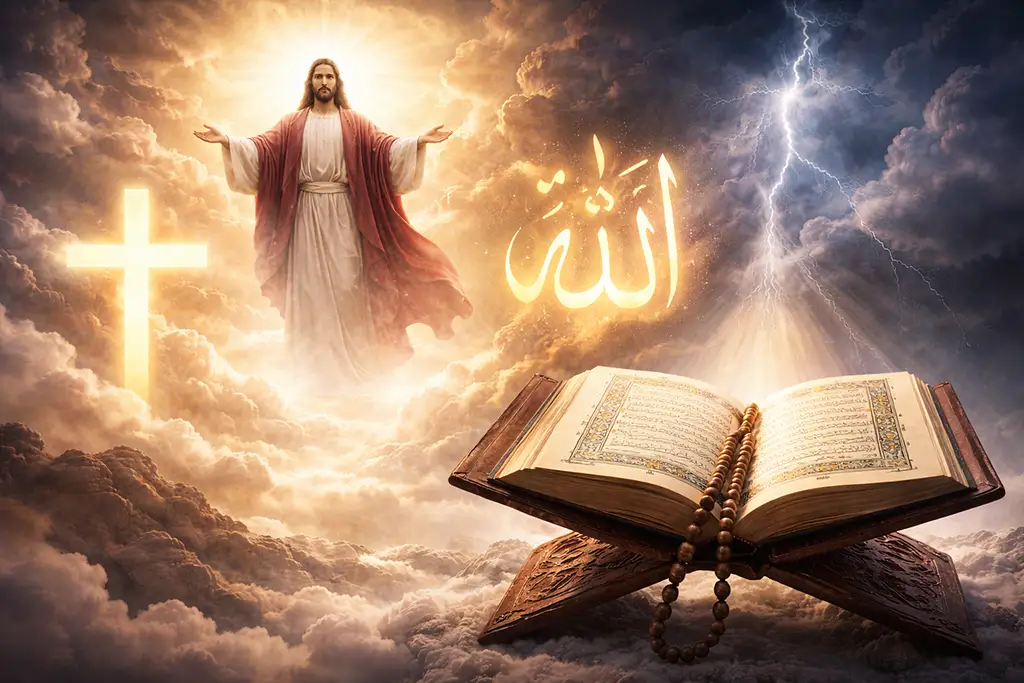
Jesus Christ: Is he the incarnate “Word of God” or just a prophet?
The question about the “nature of Christ” is the fundamental point at which Christianity and Islam meet and diverge. While the Qur’an venerates Christ and places him in a lofty position as “a word from Him” and “a spirit from Him,” Christianity believes that this title (the Word) is not merely an honorific description, but rather a declaration of God’s essence appearing in the flesh.
In this article, we will try to understand why Christians believe in the divinity of Jesus, and how this differs from the Qur’anic view, focusing on the concept of the “word” and the “image of God.”
First: Christ in the Christian faith (the Incarnate Word)
For the Christian, the divinity of Christ is not an “add-on” to Christianity but its essence. We do not believe that “a man became God,” but rather we believe that “God manifested himself in the form of a man” to reveal himself.
1. Theology of the Word (Gospel of John 1)
The Gospel, according to the Evangelist John, begins with a declaration that removes any doubt about the eternity of Christ:
“In the beginning was the Word, and the Word was with God, and the Word was God…And the Word became flesh and dwelt among us” (John 1:1, 14).
Here, the “Word” (Logos) is not a voice that ceases, but rather the “speaking mind of God” and his creative power. Christians believe that God and His mind (His Word) are one, and since God is eternal, His Word is also eternal. This Word is the one who was embodied in “Jesus of Nazareth.”
2. The image of the invisible God (Colossians 1)
In the Epistle of the Apostle Paul to the Colossians, we find an accurate description of Christ’s relationship with God:
“He is the image of the invisible God, the firstborn of all creation. For by him all things were created…All things were created through him and for him” (Colossians 1:15-16).
What is meant by “the image of God” here is not physical resemblance, but rather that Christ is the complete and visible revelation of the nature of the invisible God. He is “the radiance of his glory and the express expression of his person” (Hebrews 1:3).
Second: Christ in the Qur’anic perspective (the Messenger servant)
On the other hand, the Qur’an views Christ with great respect as one of the “most powerful among the messengers,” but it draws a clear dividing line between “the Creator” and “the creature.”
1. Denying divinity and sonship
The Qur’an confirms in several places that Christ was human, and that claiming his divinity is “extremism” in religion:
“Those who said, “Indeed, God is the Messiah, the son of Mary,” have disbelieved. And the Messiah said, “O Children of Israel, worship God, my Lord and your Lord” (Surat Al-Ma’idah: 72).
The Qur’an also rejects the concept of “taking a son” in its physical sense, which Christians also agree with (since filiation in Christianity is spiritual and essential filiation, not reproductive):
“It is not for God to take from a son. Glory be to Him” (Surat Maryam: 35).
2. “The Word” in the Qur’an: the matter of formation
Although the Qur’an calls Christ “the Word of God” (Surat An-Nisa: 171), commentators explain that what is meant here is that Christ was created with the word “Be” without a father, and not that he is the eternal divine Word.
Third: Where does the fundamental point of disagreement lie?
The disagreement is not over the “greatness” of Christ, but rather over his “identity.”
- In Islam:Christ is“Created by the Word”(Like Adam).
- In Christianity:Christ is“Creator Word”Who took on a body.
Why do Christians insist on his divinity?
If Christ were merely a prophet, his message would be merely “law” or “morals.” But Christians believe that the human problem (sin) is too deep to be solved by mere human teaching. There had to be a “divine solution.” God, in His perfect love, did not send an “ambassador” to die for us, but rather He Himself came in the form of Christ to be reconciled to man. Redemption requires a Redeemer who is unlimited (divine) and human at the same time (to act as a substitute for man).
Conclusion for thought
Dear visitor, the description of Christ as the “Word of God” in the Qur’an and the Bible is not a mere coincidence. The “word” is what expresses its owner. If you really want to know God, shouldn’t you look to His Word?
We invite you to read the Gospel with an open spirit, contemplating the person of Jesus who did not just say “God said,” but said with authority:“I am the way, the truth, and the life”.