
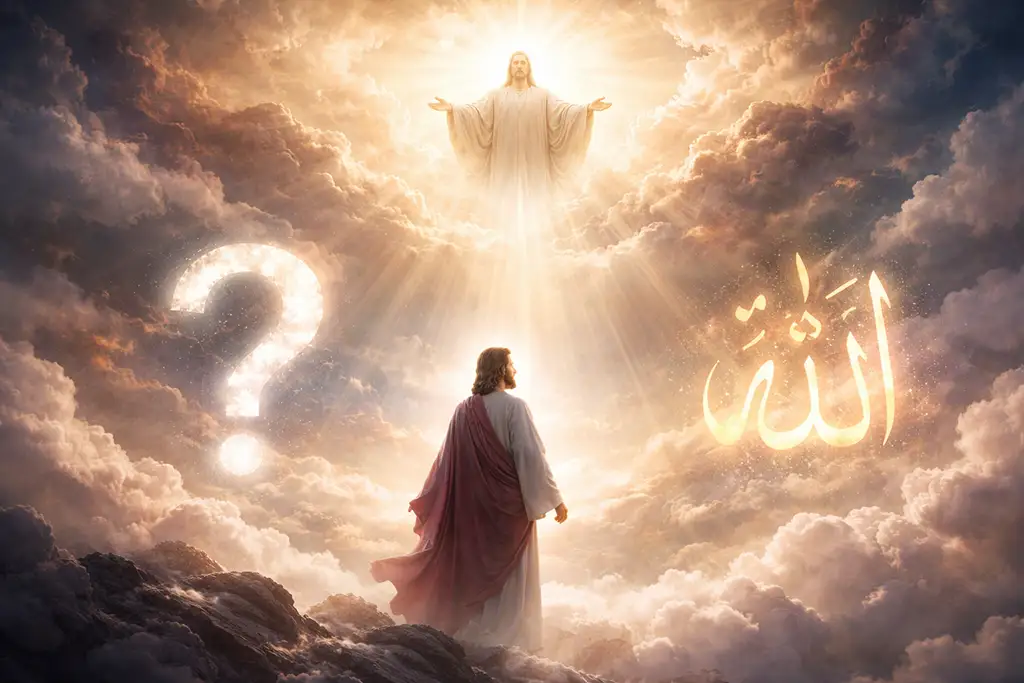
One of the terms that most raise questions for the Muslim researcher is the title “Son of God” attributed to Jesus Christ. In the Eastern mentality, “filiation” is directly linked to physical reproduction and marriage, which is rejected by reason and logic, and Christianity emphasizes its complete rejection as well.
In this article, we will explain the true biblical meaning of the title “Son of God,” and how this concept does not touch the essence of God’s oneness, but rather declares His love.
First: Denying physical filiation (reproduction)
Before we begin to explain the Christian concept, we must emphasize an important fact:Christianity completely rejects the idea that God “took” a child through mating or physical reproduction.The noble Qur’anic verse:
“He begot neither, nor was He begotten” (Surat Al-Ikhlas: 3)
It is a truth that Christians also believe with all their hearts. God is a spirit, and He is above human needs and instincts. Therefore, when a Muslim hears the title “Son of God” and procreation comes to mind, he is rejecting an idea that Christians do not believe in at all.
Second: What is the spiritual and linguistic meaning of “the Son”?
In the Arabic language and the Bible, the word “son” is used to refer toIdentity, affiliation, or unity in essence, and not always for physical reproduction. We say “son of the Nile” (to indicate belonging to Egypt), “son of the way” (to indicate the traveler), and “daughter of the lip” (to indicate the word).
1. The Son of God, meaning “from the essence of God.”
When the Bible says that Christ is the “Son of God,” it means that He is of the same essence and nature as God. Just as the ray is the “son” of the sun (it emerged from it and is one with it in nature and heat), or the word is the “daughter” of the mind (it expresses it and is one with it). The Bible says about Christ:
“Who is the brightness of his glory, and the exact image of his person” (Hebrews 1:3).
2. A title that denotes authority and divine encounter
In the Old Testament, the title “Son of God” was sometimes applied to kings or prophets to denote a special relationship with God, but for Christ, the title took on a unique meaning (the only Son), to signify that He is the only one who fully reveals God because He is one with Him.
Third: Is belief in the sonship of Christ “polytheism”?
Polytheism, in essence, is “polytheism” or making a partner for God from outside of Him. But the Christian faith affirms:
“Hear, O Israel: the Lord our God, the Lord is one” (Mark 12:29).
Christians do not believe in the existence of two Gods (Father and Son), but rather believe in one God who revealed Himself through His Word (the Son).
- father:He is God in terms of His invisible essence.
- Son:He is God insofar as He is the “Word” apparent and revealed to mankind.
The Son is not a separate “other” God, but rather “the appearance of God in the flesh.” Just as the fire of a candle is one, but it has a flame (light) and heat, so God is one, and His Word (the Son) is one with Him in essence.
Fourth: Why did God choose the title “Son”?
Some may ask: Why didn’t God use another, less controversial title? The reason isLoving. The title “Father and Son” is the most powerful human expression of intimacy, tenderness, inheritance, and profound love. God wanted to tell us that his relationship with His incarnate Word (Jesus) is not a “master-slave” relationship, but rather a relationship of eternal love, and that through this “Son,” we too can become children of God by adoption and grace.
conclusion
Dear researcher, the title “Son of God” is not a blasphemy against the greatness of the Creator, but rather a declaration of the humility of the Creator who wanted to approach us in a language we understand. Christ is the “Son of God” because he bears all the attributes of God, and because he came to reconcile us to the Father.
If you want to delve deeper, we invite you to read our article about:“Did Christ say, “I am God, so worship me”?“To complete the picture about the identity of Jesus in the Gospel.