
One of the most frequently asked questions by a Muslim friend is: “If God is all-powerful and all-merciful, why does He not forgive a person simply by repenting? Why is there a need for a cross, suffering, and redemption? Isn’t seeking forgiveness sufficient to erase sin?”
This question is very logical, and the answer does not lie in belittling the importance of repentance, but in understanding the nature of “God’s holiness” and the depth of “the problem of sin.” In this article, we will review why redemption is the ultimate expression of God’s justice and mercy.
First: The difference in the two religions’ view of sin
To understand the need for ransom, we must first understand “what is sin?”:
- In the Islamic perspective:Sin is often a “misstep” or “violation of a legal order.” Man is by nature “created weak,” so if he asks for forgiveness and repents, God (the Forgiving, the Most Merciful) erases this bad deed, and may replace it with a good one.
- In the Christian perspective:Sin is not just a wrong action, but a “separation from the source of life” (God). It is like a fatal disease that has afflicted human nature, or a legal debt that the debtor cannot pay. The Bible says:“For the wages of sin is death” (Romans 6:23).
Second: The dilemma of “justice” and “mercy”
Imagine a just judge whose son stands before him, accused of a crime that requires a huge financial fine that the son does not have.
- If the judge pardoned his son simply because he was a “loving father,” he would beAn unfair judgeBecause he broke the law.
- If his son is sentenced to prison, it will beA fair judgeBut it isAn unmerciful father.
How does God solve this dilemma?God is perfect in His justice (He does not leave sin unpunished) and perfect in His mercy (He does not want the sinner to perish). The divine solution was in “redemption”: God (the judge) pronounces the just judgment, and then He Himself descends from the judgment seat (in the form of Christ) to pay the fine on behalf of the Son. Thus, God remains just and merciful at the same time.
Third: The concept of “redemption” in religious heritage
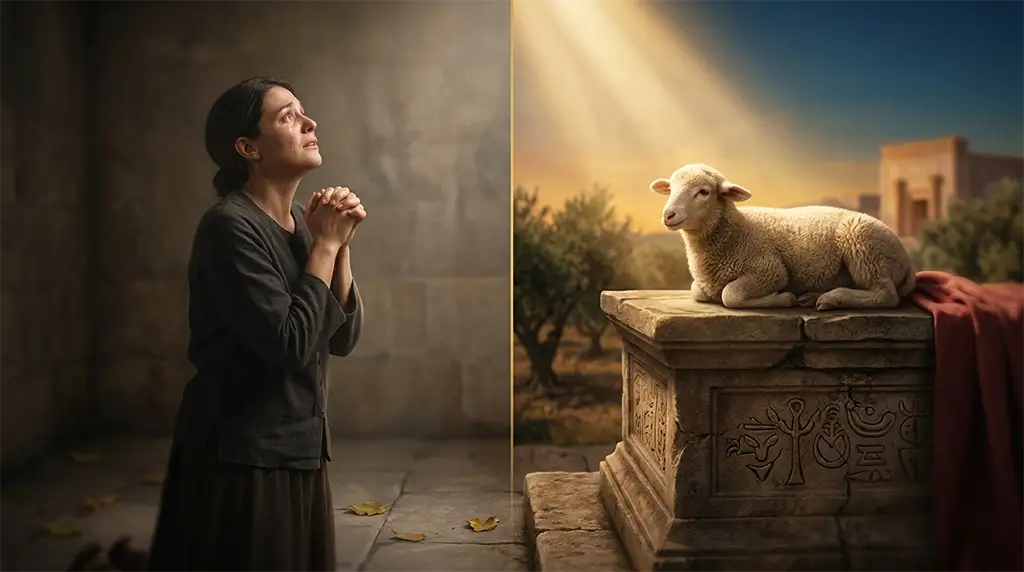
The idea of ransom is not foreign to religious thought. Let us consider the story of Abraham and his son (mentioned in the Qur’an and the Bible): when God commanded Abraham to offer his son as a sacrifice, then at the last moment he presented him with a ram to ransom him. The Qur’an says:
“And We ransomed him with a great sacrifice” (Surat As-Saffat: 107).
This “great slaughter” was a sign and symbol of what God would do later. If the life of a human being (the son of Abraham) needed a ram to redeem it, how much more do the sins of all humanity need a “greater and loftier sacrifice”? Christ is the “great slaughterer” who redeemed humanity.
Fourth: Why is repentance alone not enough?
Repentance is very necessary, but it addresses the “future” and does not address the “past.”
- If someone hits another person’s car, is it enough to say “I’m sorry and I won’t do it again” (repentance) to get the car repaired? Of course not. Repentance prevents the accident from recurring, howeverJusticeIt requires repairing the damage or paying the price.
- Sin directed against the (infinite) God is an infinite offense, and therefore requires infinite atonement. Repentance expresses our remorse, but it is the “blood of Christ” that pays the debt and cleanses the conscience.
“Without shedding of blood there is no forgiveness!” (Hebrews 9:22).
Fifth: Redemption is the pinnacle of love
In Islam, God forgives because He “wills” to forgive. In Christianity, God forgives because he “suffered” in order to forgive. Redemption shows us the value of man to God. He did not content himself with issuing a “royal pardon” from afar, but he came and became incarnated and shared our suffering and bore our sins in his body on wood, so that we could be freed.
Conclusion for thought
Dear visitor, repentance is your hand that extends to receive the gift, but “redemption” is the price that was paid in order for this gift (forgiveness) to be available to you. God does not want you to live in constant worry: “Has God accepted my repentance or not? Is the scale of my good deeds heavier than my bad deeds?”
With Christ, you can rest assured, because the debt has been paid in full, and all you have to do is accept this redemption with a repentant and believing heart.