
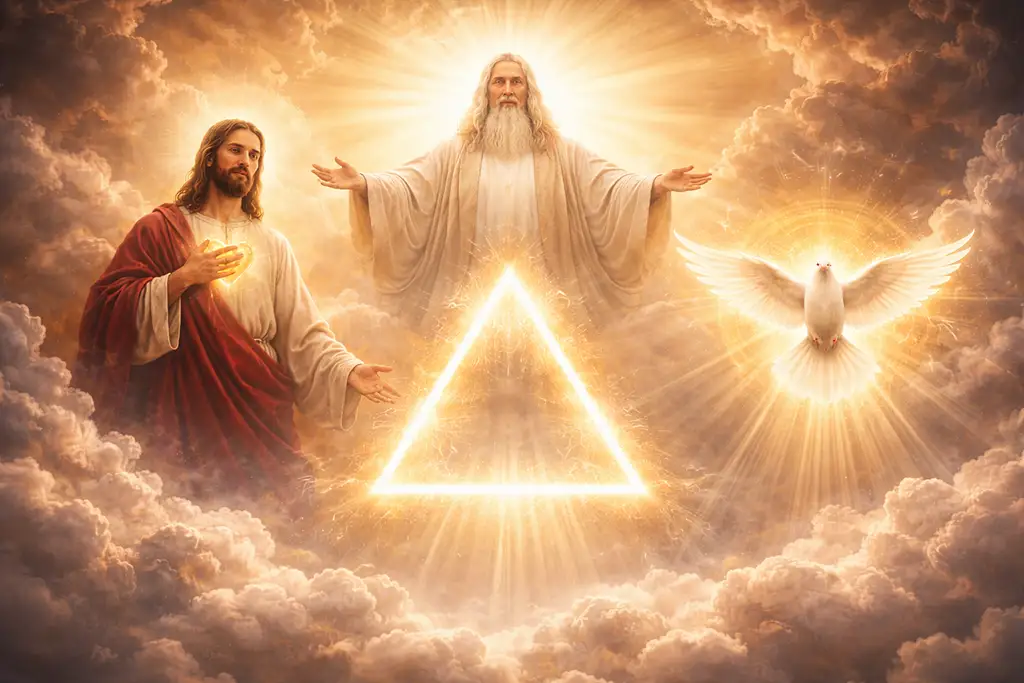
Understanding “Monotheism” in Christianity
One of the biggest challenges facing a Muslim friend when reading the Bible or talking with Christians is the term “The Holy Trinity.” The mind that was raised on the absolute unity of God may see in “the Father, the Son, and the Holy Spirit” a kind of polytheism or polytheism.
In this article, we will explain the truth about the Christian faith:We do not believe in three gods, but rather in one eternal God, who has a self that speaks his word and is alive by his spirit.
First: The declaration of oneness in the Holy Bible
Above all, every researcher must know that Christianity is a monotheistic religion par excellence. The Christian Constitution begins with an explicit declaration:
“Hear, O Israel: the Lord our God, the Lord is one” (Mark 12:29).
Christianity completely rejects “pluralism”, and agrees with the Quranic vision that rejects having gods other than God:
“And do not say three things: ‘Desist. It will be better for you. God is but one God.’” (Surat An-Nisa: 171).
Christians completely agree with his statement, “God is one God,” but the disagreement lies in our understanding of what “one” means; Is it a “static” one or a “plural in Unity” one?
Second: Explaining the Trinity simply (self, word, spirit)
The Trinity is not a calculation (1+1+1=3), but rather a description of the nature of the One God. God is not a body to be divided, but a simple spirit. The Trinity means that one God has:
- father:God as the origin of everything and the divine “self.”
- Son:God as “the Word” and the speaking mind (incarnated in Christ).
- Holy Spirit:God as “life” and effective power.
Can you imagine a God without a mind (word)? Or a God without a soul (life)?Of course not. Therefore, God, His Word, and His Spirit are one inseparable entity, just as man is one and has a mind and a spirit.
Third: Examples from reality to approximate the picture
To bring the meaning closer to the seeker of truth, we can look at some examples that God created in the universe to reflect His nature (with a slight difference):
- Sun example:The sun is one, but it consists of (the sun disk, the light emanating from it, and the heat emanating from it). We do not say “three suns”, but rather it is one sun with three distinct but not separate characteristics.
- Fire example:Fire is one, but it contains (flame, light, and heat). God has (self, word, and spirit).
- Human example:You are one human being, but you have (an entity, a mind, and a soul). If you speak to me with your mind, then you are the one who spoke to me. If you are present with your spirit, then you are the one who is present.
Fourth: Is this “polytheism”?
Polytheism is when you associate with God another god “from outside Him” (such as the idols of Mecca or the gods of Greece). As for the Christian Trinity, it is “inside” the oneness of God.
- The wordIt is not another god, but the word of God.
- the spiritShe is not another god, but rather the Spirit of God.
In the Qur’an, Christ is described as:
“His word He conveyed to Mary and a spirit from Him” (Surat An-Nisa: 171).
The Christian literally believes this; Christ is the “Word” that came from God, and He is the “Spirit” that dwelt among us. If the Word and the Spirit are from “the essence of God,” then how can belief in them be polytheism?
Fifth: Why do we need to mention the three “Histories”?
Some may ask: Why don’t we say “God is one” and be satisfied? We mention “the Father, the Son, and the Holy Spirit” because God revealed Himself like this in the Bible so that we can understand His work in our lives:
- fatherHe loved us and created us.
- Son(The Word) was incarnated to redeem us and save us from sin.
- Holy SpiritHe lives in our hearts to guide us and sanctify us.
He is one God, but He is not an isolated God, but rather a God of “relationship” and love.
conclusion
Dear visitor, the oneness of God in Christianity is rich, living, and revealed. We do not worship three, but rather we prostrate to the one and only One who shines his light in our hearts through his incarnate Word, and revives us with the breath of his Holy Spirit.