
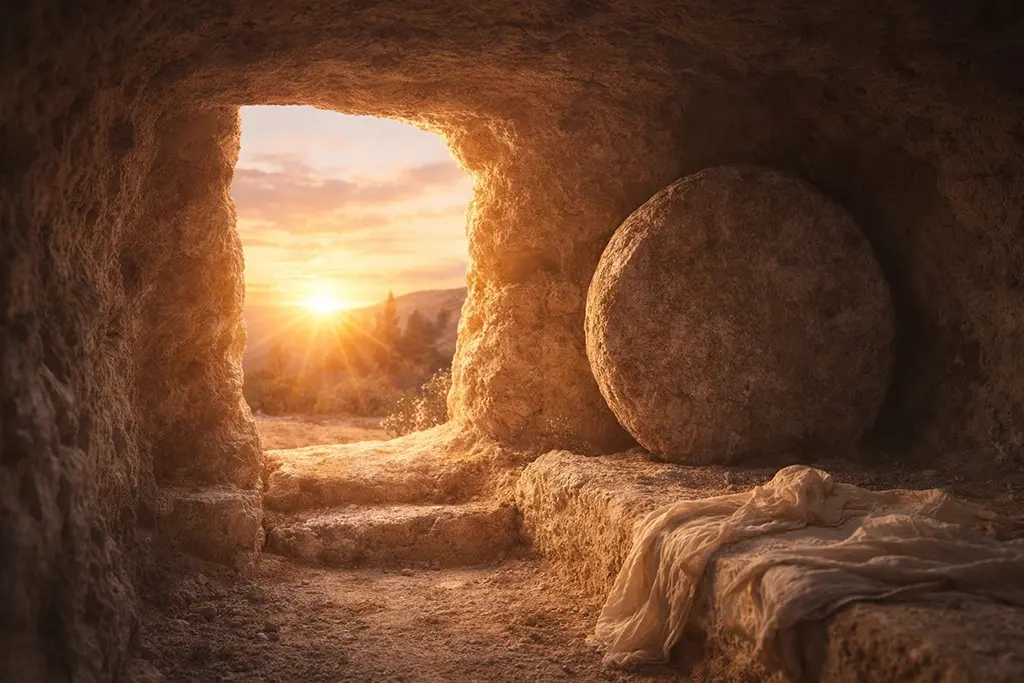
The resurrection of Christ is the heart of the Christian faith. Without it, as the Apostle Paul says: “Our preaching is in vain and your faith is also in vain” (1 Corinthians 15:14). So, what is the evidence that makes millions of people throughout history believe in this supernatural event?
First: The truth about the empty grave
Let’s start with the first fact that historians do not dispute: Jesus’ tomb was empty on Sunday morning.
Christ’s disciples did not go to another place to announce his resurrection, but rather they went to his grave itself. If his body was still there, it would have been very easy for their opponents to exhume the body and silence them forever. But they didn’t.
The Jewish account itself (quoted in Matthew 28:11-15) acknowledges that the tomb was empty, but says that the disciples stole the body. So, even opponents admit that the grave has become empty! The only difference is how empty it became.
Second: Many eyewitnesses
The Apostle Paul wrote his letter to the Corinthians around the year 55-57 AD, that is, only about 25 years after the Resurrection. He gives us a list of witnesses to the Resurrection:
“That Christ died for our sins… and that he was buried, and that he rose again on the third day… and that he appeared to Peter, and then to the Twelve. After that he appeared to more than five hundred brothers together, most of whom remain until now” (1 Corinthians 15:3-6).
This is testimony written during the lifetime of most witnesses. Paul challenges readers to ask themselves: “Most of them remain until now.” This is very strong evidence that these apparitions were known and accepted in the early church.
Third: The transformation of the disciples
Look at the disciples before the resurrection: they were afraid, running away, Peter denied him three times, and John ran away naked. After the Resurrection: The same men faced death with courage, and most of them were martyred because of their belief in the Resurrection.
What changed them? Could they die for a lie they know is a lie? It is impossible for a person to choose to die for something he knows is not real. But they were willing to die because they saw that Christ had truly risen.
Fourth: His appearance to different characters
The apparitions were not only of the disciples, but of various personalities:
- Mary Magdalene: A woman, and in the culture of that time, a woman’s testimony was not legally acceptable. If the story were made up, they would have chosen male witnesses.
- Thomas the doubter: Who refused to believe until he saw for himself and touched the wounds. The appearance of Christ to him was a special message to skeptics.
- Paul (Saul of Tarsus): The greatest enemy of the Church, who persecuted Christians. The appearance of Christ changed him 180 degrees and he became the greatest missionary of Christianity.
- James, brother of Jesus: Which he did not believe in during his ministry (John 7:5). The appearance of the Risen One transformed him into the leader of the church in Jerusalem.
Fifth: The first day of the week
For Jews, the Sabbath is a holy day of worship. But the first Christians, who were Jews, began to worship on “Sunday” (the first day of the week). Why? Because Christ rose on this day. This radical change in an established custom that is thousands of years old can only be explained by their certainty that something great happened on that day.
Sixth: What about other theories?
Many tried to explain the resurrection without believing in it, but all attempts failed:
- Theft theory: How did the disciples steal the body and the guards at the tomb? Why would they steal it and then die for a lie?
- Fainting theory: That Christ did not actually die, but rather fainted. But could a person, after 39 lashes, crucifixions, and spear stabs, come out of the grave wrapped in shrouds, roll away the huge stone, and convince his disciples that he rose victorious over death?
- Hallucination theory: Can more than 500 people at different times and places hallucinate the same person? Does an entire group (such as 500) hallucinate the same thing at the same time?
- Conspiracy theory: If the disciples had made up the story, they would have presented the Messiah they expected (a political savior). But the risen Christ appeared completely different from what they expected.
Seventh: What about Christ going to India or escaping death?
Some modern accounts (which have no historical support) say that Jesus did not die, but rather went to India or Kashmir. These theories:
- There is no evidence for it in any ancient historical manuscript
- It contradicts all historical sources (Christian, Jewish, and Roman) that confirm his death
- It contradicts the Qur’an itself, which says: “When God said, ‘O Jesus, I have caused you to die’” (Al Imran 55), and the word “to cause you to die” means taking his soul and putting him to death.
Eighth: Why does this matter to us?
The analogy is important to us because it proves who Christ is. If he had remained dead, he would have been just a good prophet or teacher who died like others. But he rose, and this proves that he is the Son of God, and that his death was an atonement accepted by the Father.
As Paul says: “And if Christ has not been raised, your faith is in vain; you are still in your sins” (1 Corinthians 15:17).
Conclusion for thought
The Resurrection is the most documented event in ancient history. The evidence for it is many and varied, and no one throughout history has been able to provide another convincing explanation that explains all the facts: the empty tomb, his multiple appearances, the conversion of the disciples, and the birth of the church.
Christ has truly risen! This is the heart of the good news.